
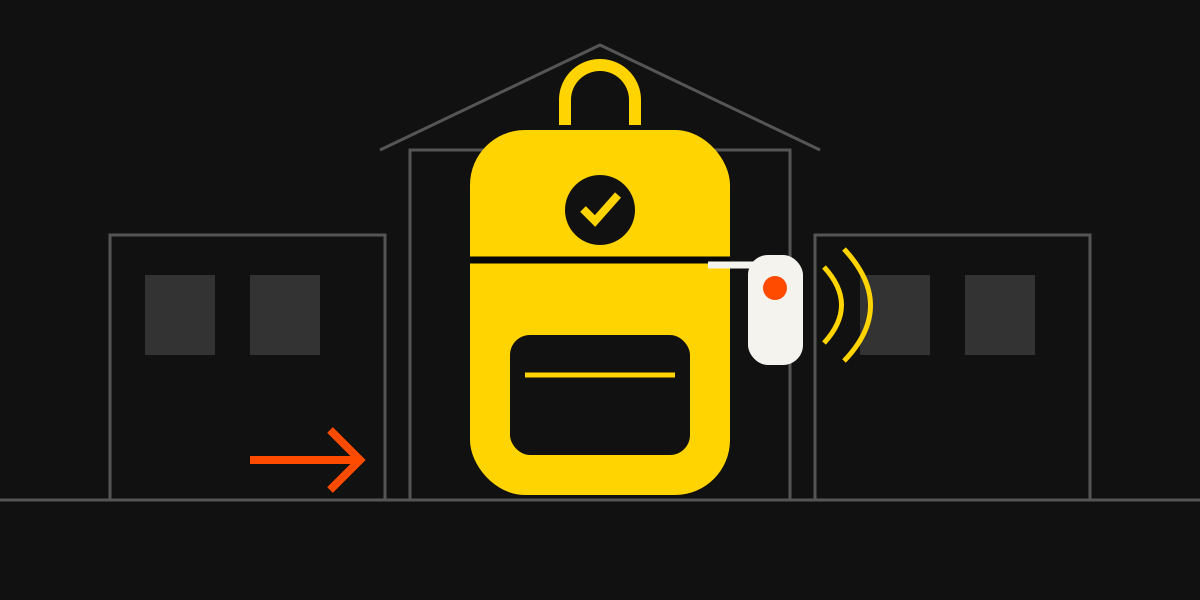
Imagine a child leaving an after-school activity. A person waiting nearby says, “Your parent sent me. Come with me.” The child recognizes neither the person nor the car. Instead of stepping closer, the child stays near the school entrance, returns to the staff member on duty, and asks for help checking the pickup plan.
This imagined situation shows why a simple family plan matters. An alarm could help attract attention. A suitable GPS device could provide a caregiver with location information. But neither replaces the most important step: getting to a safe adult and checking before leaving.
For school-age children, safety tools should support an age-appropriate routine, not make a child responsible for handling danger alone. The aim is to get away and get help, not to hurt someone. Parents, caregivers, and school staff remain the people responsible for protecting children.
1. Start with a plan your child understands
Choose a small number of clear instructions you can repeat in ordinary language. Agree on who picks your child up, where the meeting point is, and what happens if that person is late. Show your child the school office or other staffed place where they can wait safely.
Make changes through the school’s approved process. A message delivered by an unexpected person is not enough to change the plan. Your child can say, “I need to check with my teacher first.” They do not need to debate the person’s story or walk to a car to hear more.
For children who walk, travel the route together before considering independent journeys. Point out crossings, staffed businesses, and places to ask for help. Decide what to do if a route is blocked or an activity finishes early. Adjust supervision to your child’s development and the surroundings.
Ask your child to explain the plan back in their own words. A child who can repeat a rule may still need help using it in a busy pickup area. Keep instructions short enough to remember, and give caregivers the same information so your child hears one consistent message.
2. Make a personal alarm part of the help plan
A personal alarm makes a loud sound to draw attention. Some models activate with a pull pin; others use a button. Before giving one to a child, an adult should read the instructions, check age guidance, and decide whether the child can operate it comfortably. A child should not have to manage a complicated sequence in an emergency.
Agree on a secure, reachable place to carry it, using an attachment appropriate for the child and the manufacturer’s guidance. Avoid improvised cords around the neck. Check with the school before sending an alarm, and make sure staff know what the sound means and how to help.
Practice locating and handling it without repeatedly sounding it. Any sound test should follow the instructions, happen with adult supervision, and stay away from ears. Consider sensory sensitivities and hearing needs. An adult should manage batteries, repairs, and any small loose parts.
Explain what happens next: “If you need help, make noise and move toward your teacher or another safe adult.” An alarm is not a reason to stand still. If it is out of reach, the child should leave without it. A sound-only alarm does not call 911, send a parent a message, or share a location.
Our personal safety alarm guide explains what to consider before choosing a model.

3. Understand what GPS trackers can and cannot do
A family considering a GPS tracker should check the exact product, not just the word “smart” on its packaging. A GPS device estimates a location using satellite signals. Sharing that location with a caregiver requires a working communication method, which may involve cellular service and a subscription. Check the service requirements before buying.
An item finder may use a different system and may be designed to locate keys or a bag. That does not make it a child-safety GPS device. Our Smart Trackers help locate belongings. For child-location tracking, choose a device specifically designed and supported for that purpose, with confirmed location updates, coverage, and caregiver controls. Do not use an item finder as a substitute for a child-location device.
Even a suitable GPS tracker has limits. GPS.gov explains that buildings, trees, and indoor use can reduce location accuracy. Check the time of the last update and the device’s connection status. A dot on a map is information to assess, not proof that a child is safe or an exact description of their surroundings.
Test any chosen child-location device along your normal routes with an adult present. Check battery life, coverage, notification settings, and who receives alerts. If a device is attached to a backpack, its position may show the backpack after the child puts it down. Keep a clear plan for when the device is off, lost, or unavailable.
Restrict account access to approved caregivers, use strong account security, and explain tracking to your child in language they understand. Review who can view or share the location. Never post access links publicly or assume every contact needs permission to see a child’s movements.
Check before relying on a tracker
- What location technology does this exact model use?
- How does it send updates, and what service does it need?
- How can I tell an old location from a recent one?
- Who can see the location, and how do I remove access?
- What is our plan if the device stops working?
4. Teach boundaries, not fear of every stranger
Children need to recognize unsafe behavior even when a person seems friendly or familiar. Asking a child to leave without permission, keep an uncomfortable secret, or approach a vehicle can be a reason to step away and check with a trusted adult.
The National Center for Missing & Exploited Children’s KidSmartz guidance teaches families to focus on situations and behavior rather than appearances. It also explains that some unfamiliar adults can help a child in need, such as a store employee wearing a name tag, a uniformed police officer, or a parent with children.
Make those ideas concrete. During a normal visit to a store, point out the staffed checkout or customer-service counter. At school, identify the office and the staff your child can approach. Teach your child to ask for help where other people can see them, rather than going somewhere secluded with a person they do not know.
Reassure your child that they can tell you about something confusing or uncomfortable, including behavior from someone they know. They do not have to decide whether it was “serious enough” before speaking. If one adult does not help, encourage them to tell another safe adult.
5. Practice moving away and asking for help
Give your child a short phrase they can use: “No. I need help.” If someone is trying to take them, “This person is trying to take me” tells bystanders what is happening. The focus is being heard and reaching help, not winning an argument.
The American Academy of Pediatrics recommends practicing saying no, moving away quickly, and yelling for help. Rehearse calmly, with the child’s knowledge and agreement. Never stage a surprise abduction or ask a stranger to test your child.
If a person approaches in a car, the child should keep away from the vehicle and move toward the agreed safe place. They should not get closer to read a phone, accept a gift, or give directions. Avoid routes that lead into traffic or an isolated area.
If an alarm is already within reach, it can support a call for help. It should never delay escape. Leave belongings behind if necessary. Once the child reaches help, an adult should take over, contact emergency services when needed, and keep the child with a safe caregiver.
6. Rehearse everyday problems without frightening your child
Use ordinary situations to build confidence. Ask, “What could you do if I am not at pickup yet?” Then walk to the waiting place together. On another day, ask, “Who could help if you lose sight of me in this store?” Find the staffed counter rather than turning it into a scary quiz.
For a child who becomes separated in a public place, agree on a plan before entering. Teach them to stop wandering, stay in a safe visible area, and ask an appropriate helper to contact you. If they are in immediate danger, moving to safety comes first. Do not teach a rule that requires them to stay beside a threat.
Practice saying a caregiver’s name and phone number when developmentally appropriate. An emergency contact card kept privately inside a bag can help, but do not display personal details publicly. If your child uses a phone or watch, show them how to contact you and what to do if you do not answer.
Adapt the plan for mobility, speech, learning, and sensory needs. A child may need a picture card, a communication device, closer supervision, or a different alarm. Discuss individual needs with school staff and, when appropriate, your child’s pediatrician. The plan should fit the child rather than require the child to fit a gadget.

7. Respond quickly and support your child
If your child reports an unsafe approach, listen calmly. Thank them for telling you and make sure they know it was not their fault. Record what they can share without repeatedly questioning them, and notify the school or other responsible adults as appropriate. Call 911 for an immediate threat.
If your child is missing, contact law enforcement immediately. Do not wait for a tracker to refresh or spend time troubleshooting an app first. The FBI advises parents not to wait to report a missing child. Share the latest known location, a recent photo, clothing details, and any device information with responders.
A child who freezes, cannot shout, or forgets the plan has not failed. Safety education should offer options and support. It never makes a child responsible for preventing another person’s harmful actions.
Choose a tool that supports your family
Safety Tech Devices offers personal alarms and item finders. Start with the child’s needs and your school’s rules, then check the exact product’s instructions and suitability. Keep alarm-only devices separate from products with chemical or electrical defense features. This child-safety story is about attracting help and reaching safety, not equipping children for confrontation.
Browse our personal alarm guidance and individual product details with your family’s routine in mind. For any GPS device, verify its child-location features separately. No purchase replaces supervision, a safe pickup process, or a child knowing who will help.
Before the next school day
- Confirm the pickup person, waiting place, and backup contact.
- Identify the school staff member your child can approach.
- Check that any permitted alarm is reachable and working.
- Review any tracker’s charge, connection, and access permissions.
- Practice one clear request for help.
- Remind your child they can always tell you something feels wrong.
Keep the conversation calm and revisit it when routines change. A new activity, bus route, or caregiver is a good reason to practice again together.
Frequently asked questions
Can a personal alarm keep my child safe on its own?
No. An alarm may draw attention, but it does not stop someone, guarantee help, or replace adult supervision. Choose an age-appropriate model, follow its instructions, check school rules, and practice a simple plan for moving toward a safe adult. A child should never delay getting away to find an alarm.
Does a personal alarm tell me where my child is?
A basic sound-only alarm does not share a location or call a parent or the police. Those functions require specifically described connected features. Read the exact model’s instructions rather than assuming that an alarm, tracker, and emergency calling device do the same job.
Are your Smart Trackers GPS trackers for children?
Our Smart Trackers are offered as item finders for belongings. Do not assume that an item finder provides GPS child location, live monitoring, or emergency calling, and do not rely on it as a child locator. A family considering GPS should verify the exact device’s location technology, coverage, age suitability, and privacy controls.
What should a child do if someone tries to take them?
Move away if possible, shout clearly for help, and head toward a nearby safe adult or staffed place. Use an accessible alarm if it can be activated without delaying escape. Do not stop to collect belongings. Once safe, tell a trusted adult right away. Adults should call 911 for an immediate threat.
What if my child freezes or forgets the plan?
Offer reassurance and support. Freezing or forgetting does not make a child responsible for another person’s actions. Practice again calmly when your child is ready, and adapt the plan to their age, communication, mobility, and sensory needs. Adults remain responsible for protection and follow-up.
